BobsPlumbingVideos.com

Real Life Plumbing Advice for People Who Don't Want To Call A Plumber

  • Home
  • How-To-Fix Videos
    • General Plumbing
    • In The Kitchen
    • In The Bathroom
    • Toilet Repairs
    • Heating Problems
    • Hot Water Problems
  • Plumbing Articles
    • Quick Tips
    • Tool Reviews
    • Bobs Recommended Tools
  • About BPV
    • About Bob Sessa
    • Press Photos
    • Follow BobsPlumbingVideos.com
    • Find a Local Plumber – Coming Soon!
  • Got A Plumbing Problem? Ask Bob
You are here: Home

How To Cut Out a Toilet Flange Bolt.

June 12, 2014 By BobsPlumbingVideos Leave a Comment

I don’t know for sure where the majority of viewers of this website are located but I can tell you that if you’re in the New York City area and you’ve ever tried to remove a toilet bowl, chances are the flange (toilet) bolts aren’t coming off. That’s just the way it is in the plumbing world, so what do you do when faced with having to remove a toilet and the bolts spin endlessly in either direction. Well the only good choice to is cut them off and I would caution you not to go and grab your super heavy duty electric or battery powered reciprocating saw to do it. A good old traditional hack saw will do the trick or even better a Lenox close quarter mini saw like the one I’m using in the video. If I have the room I’ll always try to saw them off between the brass nut and friction washer, but that’s not always possible because of the tight quarters in most bathrooms here in N.Y. City. Unless I’m replacing the bowl I have to be real careful about damaging the porcelain with my hacksaw.So when I don’t have the room I’ll always make a vertical cut right thru the center of the bolt thru the nut down to the friction washer.

You can use a full size hacksaw to do this, but I gotta tell you I’m partial to my mini hack saw for just about every small cutting cutting task I perform. Now in the real world the bolt won’t be in a vise and in some cases it could proceed to rotate or spin around. When this happens I’ll just grab the nut with my leather-man tool or pliers until I get my saw blade started. Once the blade starts to make it’s way down it will make it’s own path and you can release the bolt. Now that you’ve made it down to the friction washer grab a “chopping” screwdriver, place it in the cut a tap a few times with your hammer and you should be good to go.

Use some caution here, you want to attack it from the side and not hit it like a madman. Keep in mind the bowl is porcelain and it doesn’t take much to crack it. If your cut is all the way down to the friction washer you shouldn’t have any issues at all. If you have questions or didn’t understand something you can always reach me at info@bobsplumbingvideos.com. Thanks for dropping by and I’ll see you in the my video. HAPPY PLUMBING!

Filed Under: How-To-Fix Videos, In The Bathroom

Burst Hose Bib? Must be Spring!

April 16, 2014 By BobsPlumbingVideos Leave a Comment

As the fall approaches and the temperatures start to drop, I’ll always offer to shut off the cold water supply line feeding the garden hose for my customers. Depending on how close we are to the extreme cold weather, some will say yes that’s a good idea and thank me while others will tell me they would like to keep the water on a long as possible. Especially those car enthusiasts who like to wash and detail their own vehicles.  Hey I get that, I like to wash and detail my own car so I smile and say No Problem! But don’t forget to shut it off before the temperature drops below 32 degrees.

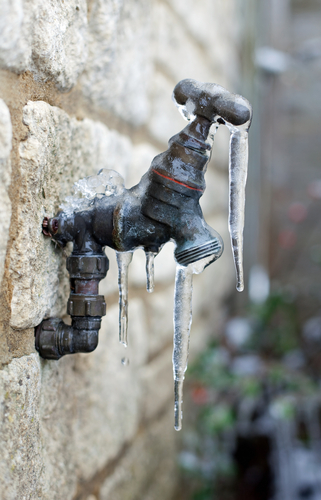
frozen hose bibDo you know that every year like clockwork those same customers would call me back in the spring in a panic saying they heard running water from somewhere? When I arrive to investigate I ultimately find that the cold water line feeding the front or rear yard hose line burst. Actually the pipe burst and split open during an extreme cold snap. When I get the call it’s usually as the pipe starts to thaw which could be weeks after the damage occurred. Funny thing is that on all of my service calls I make it a habit to tag (bright day-glow orange) every valve with its description so the homeowner will know what its function is. But without fail, the same people call me every spring for the same exact reason. Thinking back, I should have invested the fees charged for those repairs in a good mutual fund. Lord knows I’d be retired!

Retirement FundNow some of you may be saying “Hey Bob why don’t you just install a frost Free Hose Bib”? Problem Solved! In a nutshell, I hate them! So called frost free hose bibs come anywhere from 10” to 12” in length, the theory is that these extremely long stemmed hose bibs which have a traditional washer on them will shut the water off closer to the inside of the home . This is supposed to eliminate any water from reaching the outer walls of the home thereby eliminating the chances of a freeze-up. In reality these valves are more trouble than they’re worth! They leak from the packing nuts when you open them, and the washers and seats generally fail. If you Google “Frost Free Hose Bib” you’ll see exactly what I mean. I’ve worked on them occasionally, but have never installed one for any of my customers. In my opinion a good quality solid brass hose bib that’s pitched to allow the water to drain toward the outside, coupled with a good quality ball type shut-off valve will do the trick. Oh yes one mention, there is a catch! You got to remember and SHUT-OFF the WATER!. Then again you can just call me back year after year to make the necessary repairs so I can fund my RETIREMENT.

Thanks again for stopping by and watching my videos and reading my blog, I’m here to help you in any way I can. If you have an unusual plumbing problem that’s giving you a headache, please send your photos and questions to info@bobsplumbingvideos.com. HAPPY PLUMBING!


Filed Under: How-To-Fix Videos, Plumbing Articles Tagged With: burst hose bib, burst pipe, frozen hose bib, frozen pipe

How To Remove a Steam Radiator Valve – Part 2

March 4, 2014 By BobsPlumbingVideos Leave a Comment

Welcome back to this two part series about How To Remove a Steam Radiator Valve.

If you haven’t checked out part 1 of this two part series I recommend you check it out and then come on back to see the conclusion. Check out How To Remove a Steam Radiator Valve – Part 1

Ok, so let’s continue here where we left off in part 1…

Up until this point everything is pretty systematic and if you follow my instructions as illustrated this is not all that difficult to do. I often see handymen and even plumbers trying like heck to remove these valves with giant wrenches and long pieces of pipe used as leverage to screw them off.

Not only is it not necessary, but as I mention in the video you’ll most likely open yourself up to a huge plumbing repair when the fittings below the floor break off.I would say that the most challenging steps in removing the valves is making sure you don’t cut into the threads of the supply pipe coming up thru the floor or cutting the threads inside the radiator when using your full sized hacksaw or mini hacksaw. You just have to stop just a bit shy of cutting all the way thru and let your chisel do the rest. The brass is soft enough so when you hit it, it will just split apart.

The small beveled chisels I reference in the videos are used to remove that portion of the radiator spud left inside the radiator after I shear off the union nut with my hacksaw. One has a single bevel and one is double beveled, you can use either one to get the job done. They also come in quite handy when trying to remove broken pieces of pipe from all types of fittings. Now as I stated in the video I can change out a radiator valve from start to finish in 20 minutes, but it probably took me years to perfect it. The key in successfully Installing a new valve is to take your time and don’t rush thru it.

Go back to part 1 and watch how I walk you thru the steps to get this job done with the least amount of effort. Work Smart, Not Hard!

I want to thank you as always for stopping by, please leave any comments below and I look forward to seeing you in my next video.

HAPPY PLUMBING!

Filed Under: Heating Problems, How-To-Fix Videos Tagged With: how to cut out a radiator valve, how to remove a steam valve, leaking radiator valve, leaking steam valve, steam valve removal

How To Remove a Steam Radiator Valve – Part 1

March 4, 2014 By BobsPlumbingVideos Leave a Comment

Welcome back friends, especially my east coast followers who have the privilege of heating their homes with good old reliable steam heat.

In this two part video series, you’ll learn how to remove and replace a steam radiator valve.

A majority of the homes along the east coast are still being heated with steam heat whereby a good old fashioned cast iron boiler resides in the basement.The water in the boiler is heated with oil or natural gas as the fuel, it then turns into steam and gets distributed through out the steam piping system and into big cast iron radiators.

The steam enters the radiators thru shut off valves located either on the left or right side, and to this day people still try to control the amount of heat that enters the radiator by throttling the valves on or off. News bulletin my friends! These are service valves meant to shut-off or service the radiator in the event of a problem. Some of these valves have been in service for as much as 60 years and eventually they will leak.

In part 1 of this two part series I walk you through process of how I go about removing and replacing them.To the novice handy-person the tendency is to get a large wrench with some leverage on it and then try (unsuccessfully) to screw them off. A word of caution “DON’T DO IT”! I can almost guarantee that you will break off the steam fittings below the floor which will lead to an expensive plumbing repair and that means you’ll to have call someone like me which you probably don’t want to do. Pay attention to how I systematically go about removing them, I can guarantee you that once you get the hang of it you’ll never try to screw one off again!

Check out this video (part 1) which includes my recommended tools for the job and then jump on over to the conclusion of “How to Remove a Steam Radiator Valve – part two“.

HAPPY PLUMBING!

Filed Under: Heating Problems, How-To-Fix Videos Tagged With: how to cut out a radiator valve, how to remove a steam valve, leaking radiator valve, leaking steam radiator, steam valve removal

Repair Your Leaking Toilets And Save Money On Your Water Bills

February 24, 2014 By BobsPlumbingVideos Leave a Comment

repair your leaking toiletsOne of the most common complaints I receive from homeowners is that they just received their quarterly water bill and it was off the charts in comparison to the previous statement.

So I’ll ask the usual questions such as do you have any faucets or toilets that are visibly leaking? The usual response is no! Everything is fine I don’t have any leaks, why is my bill so high. Well faucets are pretty easy to pinpoint, their ether leaking or not, but toilets are another story. Although you may not visibly see or hear any water running, they could very well be the cause of your high water bill.

One cool test I often recommend is to take a little food coloring (I’ll leave the color up to you) and place a few drops inside the toilet tank and wait. Have a cup of coffee, come back and look inside the bowl. If the water has turned into your color of choice, your flapper is passing water and the fill valve is re-filling the tank when the water drops to a certain level. If you have an older style fill valve with a large float ball connected, you’ll never hear anything because it will automatically fill as the water level drops. Very quietly costing you money. If your toilet is equipped with a modern style fill valve where the float and valve are one unit, the tank will drop to a certain level after which the fill valve will turn on to replace the lost water. You’ll often hear an intermittent running of water after which it will stop. Again costing you money.
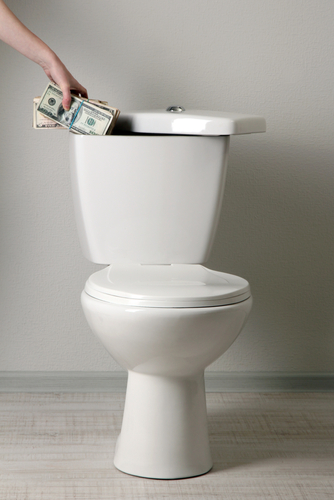
stop flushing your money down the toiletLeaking flappers are one most common causes of high water bills.They become warped and damaged over time and more so if your placing that pretty blue toilet bowl cleanser inside the toilet tank. That stuff dries out the rubber components inside the toilet tank leading to premature failure. The flapper, trip lever or chain may lose it’s alignment, leaving a gap that can cause a leak. The flush valve can develop small cuts or pitting that causes a leak between it and the flapper. The fill valve can become stuck in the open position causing water waste as it flows down the overflow tube. This can occur when their are fluctuations in water pressure.

how to test for water leaks

How can you test for these water leaks?

Listen: The only time you should hear water running in when you intentionally flush it, the tank should fill to the proper level and shut. If you still hear water after it fills, check your flapper. Also make sure your handle is tight and the chain has a little slack in it to allow the flapper to completely shut.

Look: A large leak will cause moving water in the bowl long after the tank has refilled. Rust stains inside the bowl are often an indication of corroding metal parts inside the tank caused by a leak.

Try performing that little food coloring test at least once annually to be sure you have a tight seal between the flapper and flush valve. If you find a leak or you see that your water bill has increased noticeably, check your flapper, flush valve and or fill valve. If you’re not comfortable doing it yourself, call in a reputable licensed master plumber. High water bills are often caused by leaking toilets that waste large amounts of water. If you’re unsure about your toilet or have additional questions you can always reach me at info@bobsplumbings.com or please visit the Got A Plumbing Problem? Ask Bob page on this website and drop my your question.

Until next time.
HAPPY PLUMBING!

Filed Under: In The Bathroom, Plumbing Articles Tagged With: is my toilet leaking, leaking flush valve, leaking toilet, leaking toilet fill valve, leaking toilet flapper, repair my leaking toilet, water leaks and high water bills

  • « Previous Page
  • 1
  • …
  • 7
  • 8
  • 9
  • 10
  • 11
  • …
  • 22
  • Next Page »

Voted 3rd Most Popular Site

Connect With Me

facebook twitter google plus youtube

Discover How To Fix The 7 Most Common Home Plumbing Problems Even If You've Never Picked Up A Wrench!

Simply Enter Your First Name & Email Address To Get Instant Access Now!

We will not sell, rent, give away your information. We hate spam too!

Recent Posts

  • Clogged Drain / D.I.Y.
  • Master Plumbers Exam / Practical Test
  • Bathtub Drain Stopper / Trip Waste Assembly

Categories

Like Us On Facebook

Like Us On Facebook

Newsletter · Ask Bob · Privacy Policy · Terms · Sitemap

Copyright © 2026 BobsPlumbingVideos.com · All Rights Reserved · Web Design & Marketing by Urmil Patel