BobsPlumbingVideos.com

Real Life Plumbing Advice for People Who Don't Want To Call A Plumber

  • Home
  • How-To-Fix Videos
    • General Plumbing
    • In The Kitchen
    • In The Bathroom
    • Toilet Repairs
    • Heating Problems
    • Hot Water Problems
  • Plumbing Articles
    • Quick Tips
    • Tool Reviews
    • Bobs Recommended Tools
  • About BPV
    • About Bob Sessa
    • Press Photos
    • Follow BobsPlumbingVideos.com
    • Find a Local Plumber – Coming Soon!
  • Got A Plumbing Problem? Ask Bob

Water Heater Maintenance / Double Your Water Heaters Lifespan

December 7, 2016 By BobsPlumbingVideos Leave a Comment

Should you practice “Water Heater Maintenance“? Are you a pro-active homeowner or are you the type of person that would rather wait until something goes wrong before you call for professional trade services. In a nutshell that sort of answers the question.

Speaking for myself, I’ve performed regular maintenance on my own water heaters for the past 35 years which has allowed them to live way beyond their expected demise according to the manufacturer. If “Water Heater Maintenance” sounds like something that might be of value to you, stay with me.

This past week I had to attend a required seven-hour continuing education course required every three years in order for me to maintain my N.Y. C. Master Plumbers License. I’m up for renewal July 2017. For the most part, we cover plumbing and sprinkler code updates and as a real treat the N.Y.C. Dept. Of Investigations speaks to us about the consequences of getting caught giving bribes to city inspectors.

Then a few manufacturers make their presentations about new products on market and we exchange businessleaking-water-heater cards in hopes of perhaps a sale in the future. Some of the presenters have a hypnotic effect on the group and by about 2 P.M. about a third of the class is either sleeping or zoning out. Finally, it’s 4 P.M. and they start to hand out the certificates.
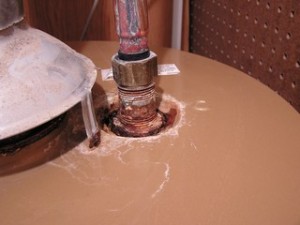
My name is called, I collect my certificate and thank the host for his thorough presentation. As I’m exiting the door a voice yells out “Bob The Video Guy”! Well besides being embarrassed and quite frankly a little surprised, I turned and it was one of the instructors of the course. I said I guess you caught me, he smiled told me he was a subscriber to my You-Tube channel and said, you should do a video on “Water Heater Maintenance“!

On the drive home, I was plotting out the video in my head when I thought rather than shoot and entire new video on “Water Heater Maintenance” why not just publicize the “Water Heater” module from my preventive home plumbing inspection routine, “The No Brainer Home Plumbing Inspection Checklist“. It’s based on the very same inspection process I practice for my own plumbing customers and hopefully, after watching it you’ll be able to identify potential problems with your water heater and perhaps avoid a plumbing emergency.

I want to give a shout out to Salvatore Mucie for a great presentation and if anyone has any questions on this or any other videos I’ve posted I can always be reached at info@bobsplumbingvideos.com. And I would also encourage you to check out the remaining modules in “The No Brainer Home Plumbing Inspection Checklist“! It might just help keep the plumber out of your life.

HAPPY PLUMBING,
Bob
Filed Under: General Plumbing, Hot Water Problems, How-To-Fix Videos Tagged With: leaking water heater, water heater care, water heater installation, water heater leaking, water heater maintenance, water heater noise, water heater service, water heater tips

Water Pipe Leak Repair / Joining Copper & Lead Pipe

November 13, 2016 By BobsPlumbingVideos Leave a Comment

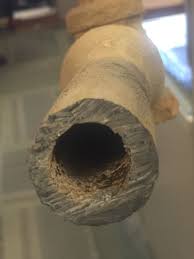
So I get a call for a water pipe leak repair coming from the ceiling of a basement in an area called Sunset Park in Brooklyn, New York. When I get to the job and head on down the basement to see what’s going on, I’m in total disbelief. I haven’t seen this much lead water pipe in a residential application for over 30 years.

The leak was coming down an interior air shaft that acted as a pipe chase for all the waste and water lines going up to the second and third-floor apartments. A brass hot water pipe was smack up against the cold water lead riser pipe and from years of expansion and contraction created a pin hole.

Now a water pipe leak repair like this was going to be a challenge for a couple oflead-pipe-image reasons. I needed access which I fortunately, was able to get via the first-floor bathroom. I had to do it standing in a bathtub working thru a double hung window which looked right into air-shaft. Second reason is I was a little shaky about using a torch in the shaft out of fear of dropping it and setting the place on fire.
Finally, I called several local supply houses to find and old fashioned lead dresser coupling so I wouldn’t have to use a flame and they all pretty much laughed at me and said “you gotta be kidding”! Plan “B” was to try a 3/4″ shark bite fitting which did fit over the 5/8″ outer diameter of the 1/2″ lead pipe and although it did clip on firmly, it was slightly big for the “O” ring to hold water.

So I no choice but to go into my bag of tricks and make the connection between the new copper pipe and old lead by soldering the two together the way it was done back in the good old days. Question was, did I still have what it takes? Well, I’d better have my shit together or this customer was going to be left with a major re-pipe which by the way he wasn’t planning on. My technique was a little rusty but kind of like riding a bike “you really don’t forget”, it just takes a little practice to get back into the swing of things.

Well, I hope you enjoy my attempt at the long lost art of lead wiping and even though it wasn’t a perfect joint (I’ve done much better), it’s water tight and that’s all that counts! By the way, I was so close to my Go-Pro 4 silver edition camera that I wasn’t paying attention to the fact that my joint was running a little hot and I probably used more solder than I should have. Never the less I got the job done and I hope you enjoy the video!

HAPPY PLUMBING,
Bob

Filed Under: How-To-Fix Videos Tagged With: copper pipe, copper pipe repair, lead pipe, lead pipe repair, leaking copper pipe, leaking lead pipe, leaking water pipe, water pipe, water pipe leak, water pipe leak repair

Bathtub Drain Leak-The Standing Waste & Overflow

October 25, 2016 By BobsPlumbingVideos Leave a Comment

In this article, I’d like to touch on the subject of a bathtub drain leak that a Youtube viewer requested. He asked me if I could talk a little bit about the classic standing barrel waste and overflow that I was weaned on while coming up in the trade.The majority of the work I performed was and still is in Brooklyn, New york.

We have many multi-family dwellings here in Brooklyn and when a call would come in for a bathtub drain leak, nine out of ten times it would be because some part of the bathtub drain rotted out and was leaking to the floor below. Back then we had huge built-in bathtubs that weren’t fitted with overflow holes like the modern ones of today.

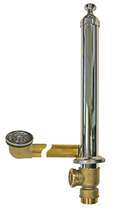
The tubs were filled by means of a Standing Barrel Waste and Overflow which consisted of a tall chrome barrel which was approximately the same height as the tub, a waste tee and a bathtub shoe and strainer. Inside the chrome barrel was the plunger that would stop up the water when you wanted to take a bath.

standing-tub-imageThe water would rise inside the barrel and to protect against a possible overflow, the inside plunger had built-in overflow hole. They worked well but to remove and replace them was a bit of job, four to five hours to be exact. In most cases, the long tub shoe would rot out or a section of galvanized pipe or the cleanout plug on galvanized tub trap would blow out. Why would you put a plug on a buried galvanized trap? Go figure!
The distance from the trap to the main cast iron drain line was pretty close, approximately 12″‘ to 18″ which was made up of a series of galvanized fittings and nipples.You often didn’t have much room to maneuver everything cause you had to deal with a beam that was always in the wrong place. But I learned how to make these seemingly impossible repairs by master mechanics would really knew their craft.

We live in different world, as the materials and techniques of today make repairing a bathtub drain leak much easier than it was back in the day. But Be warned! if you plan on coming to Brooklyn to repair a bathtub drain leak, we still have plenty of the Classic Standing Waste and Overflows in use. So check out my video and screen-cast tutorial on the subject and if you have any specific questions on the subject, please forward them to info@bobsplumbingvideos.com or leave your comments below.

Hope to Hear From You Soon,

Regards & Happy Plumbing!

Bob.

Filed Under: How-To-Fix Videos Tagged With: bathtub drain leak, bathtub drain repair, bathtub drain replacement, bathtub leak, bathtub leak repair, leaking bathutb, leaking tub drain, tub drain leak, tub drain repair, tub drain replacement

Threaded Pipe Sealant, Which One To Use?

October 1, 2016 By BobsPlumbingVideos Leave a Comment

A YouTube viewer reached out to me this past week and made a request That I do a video on threaded pipe sealant.bluetapepipes2 I guess to me pipe threaded sealant is not such a glamorous subject but after a little research, it looks like people want to know this stuff! So I shot the video to give you my thoughts on the subject.
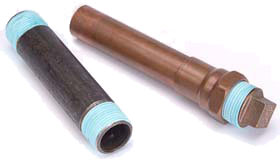
A lot of folks ask the question “do I need to use threaded pipe sealant, what kind should I use or should I use Teflon tape”? Generally speaking I would say it depends on the job circumstances, personal preference, and what you have available at the time. First, let’s talk about pipe threads. Pipe threads are made using a pipe stock & die just like the one in the video below.

They’re tapered by design and as you make up the pipe into a fitting it gets tighter the further in it goes. Tightening is always in a clockwise direction and loosening in a counter-clockwise direction. In a perfect world and a perfect set of cutting dies you should be able to make up a fitting onto a piece of pipe and it shouldn’t leak. But in the real world, there are microscopic imperfections in pipe threads that can’t be seen by the human eye.

Enter “threaded pipe sealant”. To me, the number one reason to use it is to lubricate the male
threads of a piece of pipe which will aid in the tightening process and seal any small inconsistencies in the pipe threads. How tight is tight enough? Well that’s accomplished through feel and years of practice. The fact is you can over tighten a piece of pipe which will cause the female fitting to overly expand (brass pipe in particular) causing to the joint to fail.

The threaded pipe sealants of today have come a long way since I started as a young apprentice. Back then I used a petroleum based product called “pro dope” made by the company Hercules along with a spool of plumbers wick. I would wind the wick in between the male threads, follow it up with an application of “pro dope” and I was good to go.

They still make “pro dope” and I think they’ve even made it more environmentally friendly. Fast forward to the introduction of Teflon Tape and PTFE paste thread sealants, we have many more choices in deciding which one is the best application for the job. I for one generally use a combination of Teflon Tape and PTFE pipe thread sealant on most of the everyday job’s I perform. But that could change at a moments notice.

Which one I use in a specific situation is all going to depend on the job circumstances. If I’m working on pipe that’s in good condition, I’ll use one method. If I’m working on really old questionable plumbing, I’ll use another method or a combination of two or three of the products available. I demonstrate all my techniques in the video below, so why not take a look and tell me what you think. With all the products available on the market, I can see how you might get confused. Hopefully, I cleared up some of that confusion and as usual, if you have questions, please reach out to me at info@bobsplumbingvideos.com.

Best Regards,

Bob

Filed Under: General Plumbing, How-To-Fix Videos Tagged With: blue block, grip, hercules, lampwick, plumbers tape, plumbers wick, ptft, ptft sealant, teflon pipe sealant, teflon tape

Dishwasher Air-Gaps…Do You need One?

September 18, 2016 By BobsPlumbingVideos Leave a Comment

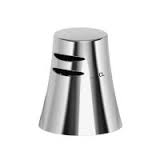
Dishwasher air-gaps are required devises in many states across the country and the best way to ensure you’re code compliant is to check with your local buildings department. Here in N.Y.C we have the option to use an air-gap or simply create a high loop in the dishwasher drain hose and secure it as high as possible under the sink base cabinet. I’ve been using the second option as described and honestly can say I’ve yet to see a counter top mounted air-gap in my everyday plumbing practice.dishwasher-air-gap

So what is the purpose of the dishwasher air-gap? It’s to prevent dirty contaminated sink drain water from backing into your dishwasher thus creating a potentially hazardous health issue. Not only is it unhealthy, but the stagnant water pooled at the bottom of dishwasher absolutely STINKS!. When I’m called in to address a leak under a sink, nine times out of ten I’ll find the dishwasher drain hose draped on the floor of the base cabinet and connected to either the garbage disposal or directly into a tailpiece.

What this does is allow drain water to migrate from the sink drain into the dishwasher and the homeowner has no clue it’s happening. They then open the dishwasher door and discover some nasty smelling water, especially if they don’t use the dishwasher that often. It’ll happen more frequently if the kitchen sink drain is partially clogged and draining slowly. The simple fix is to a. make sure the sink is draining properly and b. elevate the drain hose as high as possible and secure it to the underside of the counter top or cabinet wall. And if your state requires, the installation of a proper sink / counter mounted air-gap.

If a blockage takes place in the discharge hose between the air-gap and or tailpiece the sink mounted device will discharge water alerting you of a problem. You would be better served mounting it to the sink itself as opposed to a counter top, but each individual job will dictate what the best approach will be. If it does become clogged, you could remove the decorative cap and using the tube from a roll of paper towels attempt to blow free the blockage. On the other hand if it’s clogged with some hard food particles, you’re probably going to have to dismantle the waste hose under the sink to address the issue.

The point is dishwasher air-gaps are use to prevent hazardous sink water from getting into your dishwasher and contaminating dishes, utensils, etc. Check out the video below where I explain in detail why you need a dishwasher air-gap and an alternative option if your state does not require one. As always feel from to contact me at info@bobsplumbingvideos.com, stay well and HAPPY PLUMBING!

Best Regards,
BOB

Filed Under: How-To-Fix Videos, In The Kitchen Tagged With: air-gap, air-gaps, discharge hose, dishwasher, dishwasher air-gap, dishwasher drain, dishwasher hose, dishwasher loop, diswasher drain

  • « Previous Page
  • 1
  • 2
  • 3
  • 4
  • 5
  • …
  • 18
  • Next Page »

Voted 3rd Most Popular Site

Connect With Me

facebook twitter google plus youtube

Discover How To Fix The 7 Most Common Home Plumbing Problems Even If You've Never Picked Up A Wrench!

Simply Enter Your First Name & Email Address To Get Instant Access Now!

We will not sell, rent, give away your information. We hate spam too!

Recent Posts

  • Clogged Drain / D.I.Y.
  • Master Plumbers Exam / Practical Test
  • Bathtub Drain Stopper / Trip Waste Assembly

Categories

Like Us On Facebook

Like Us On Facebook

Newsletter · Ask Bob · Privacy Policy · Terms · Sitemap

Copyright © 2026 BobsPlumbingVideos.com · All Rights Reserved · Web Design & Marketing by Urmil Patel